How to Read a Wine List Like a Sommelier (Nairobi Edition)
You know the moment. The waiter hands you a leather-bound book with forty pages and a hundred foreign names, your table goes quiet, and suddenly everyone’s “fine with anything.” Wine lists aren’t meant to intimidate — they’re coded messages. Once you know the five things a list is secretly telling you, you’ll order with the calm of someone who does this every night. Because after this, you will.
The Five Things Every Wine List Is Telling You
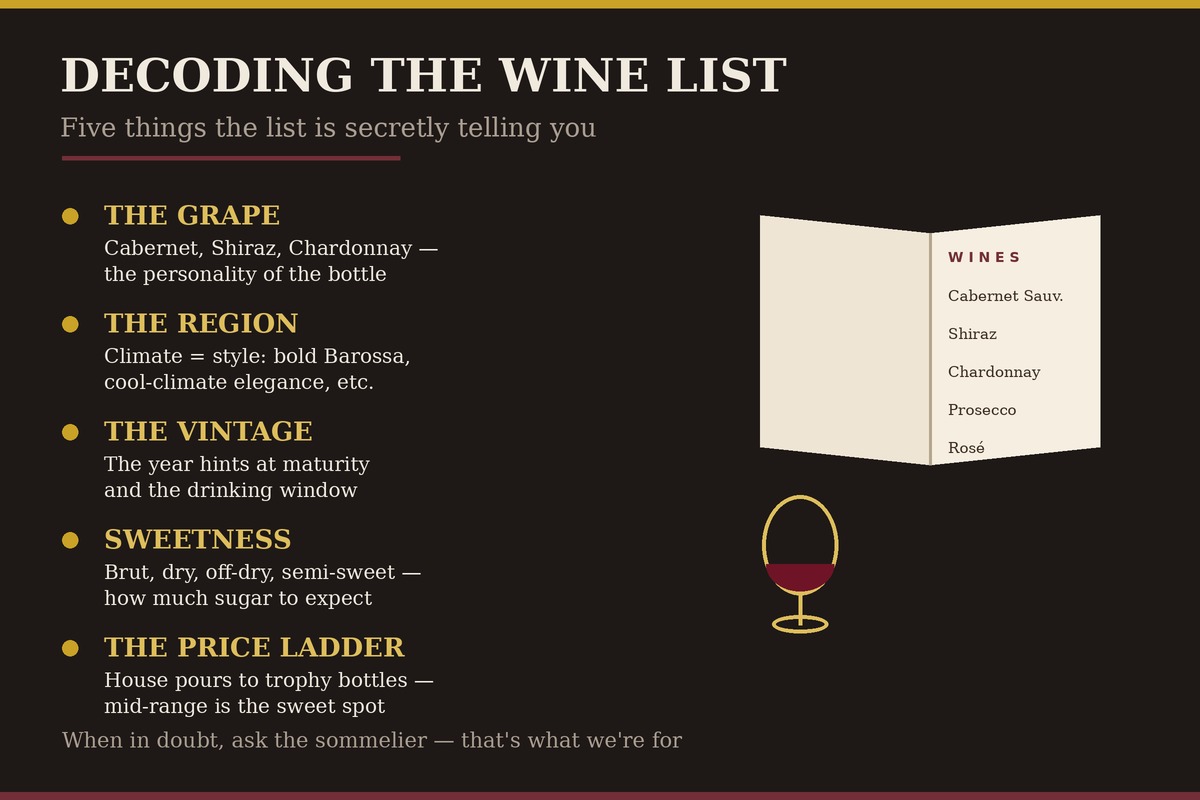
A good sommelier builds a list the way a chef builds a menu — everything is there for a reason, and the structure itself is a set of hints. Here’s how to read it.
1. The grape is the personality
Cabernet Sauvignon is confident and structured — the suit of wines. Shiraz is its spicier, louder cousin. Chardonnay ranges from crisp apple to buttery toast depending on where it’s grown. Sauvignon Blanc is the extrovert: herbal, citrusy, impossible to ignore. If a list is organised by grape, the sommelier is telling you to choose by mood, not by price.
2. The region is the style
Climate writes the flavour. Warm regions like Australia’s Barossa produce bold, jammy reds; cooler areas deliver elegance and acidity. On a Nairobi list you’ll mostly meet South Africa, Argentina, Australia, and Europe — each a reliable shorthand. “South African Chenin Blanc” tells you freshness and value before the bottle even arrives.
3. The vintage is the age
The year on the label matters more for reds than whites. Most wines on a restaurant list are made to drink young — that 2023 Shiraz is not a problem, it’s the point. If a sommelier has kept a bottle back a few years, you’ll usually find it in a separate “cellar” or “reserve” section. That’s where the trophies live.
4. Sweetness words are a scale
Champagne and sparkling sections hide the most confusing vocabulary: Brut means dry, Extra Dry is actually sweeter than Brut (yes, really), and Demi-Sec means noticeably sweet. For still wines, “semi-sweet” and “off-dry” do exactly what they say. When in doubt, ask — ordering a sweet wine by accident is the most common first-timer’s regret.
5. The price ladder has a sweet spot
Nearly every list is built as a ladder: approachable bottles at the bottom, statement bottles at the top. The quiet secret of the trade is that the middle rungs carry the best value — the margins shrink as the prices climb. Our own wine list starts around KES 4,000–4,800, where we’ve deliberately stacked the value.
How to Order Without Pretending
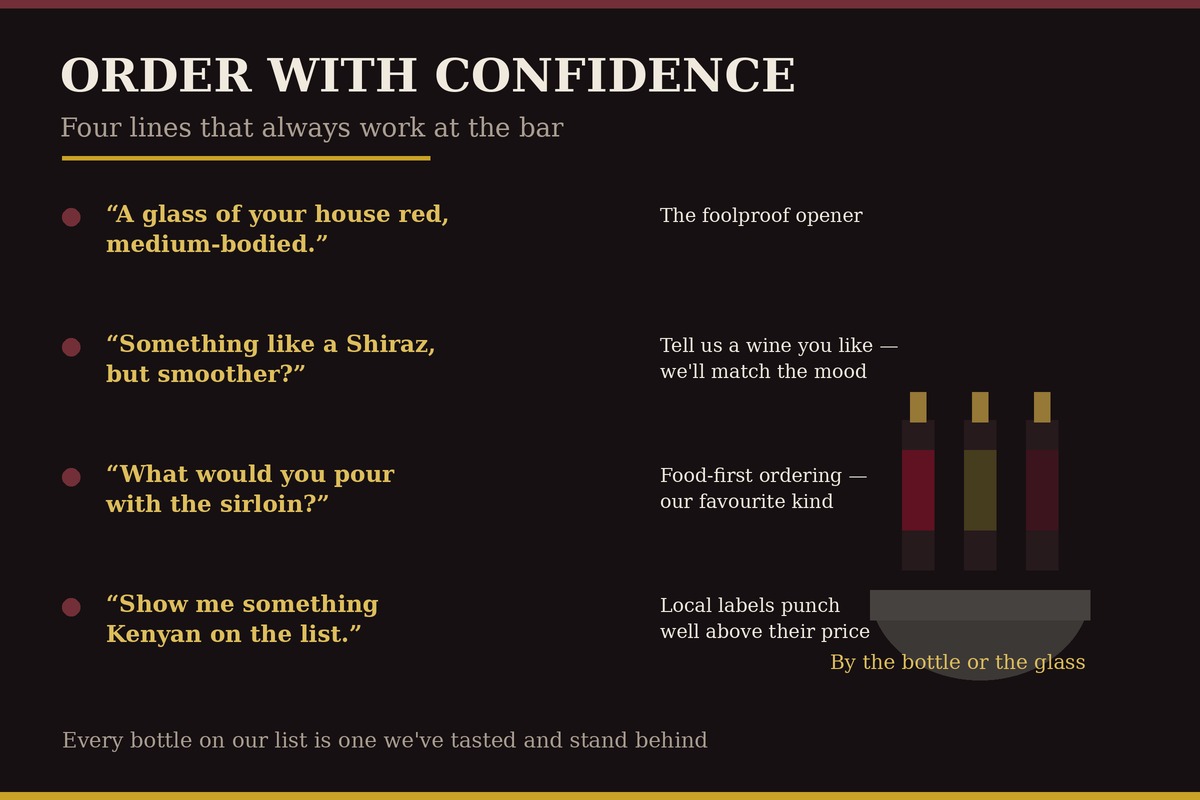
You never need to bluff. Sommeliers — ours included — light up when a guest gives them something to work with. A wine you liked last month, a dish you’re eyeing, a budget you’re comfortable with: any of these is a perfect order. Here are four lines that work in any wine bar worth its cellar:
The Kenyan Question: What’s Local Like?
Kenyan wine is the country’s best-kept secret. Vineyards in the Rift Valley produce whites of real character — crisp, aromatic styles that over-deliver against imported bottles at the same price. At The Wine & Bottle we’re proud to pour Kenyan labels alongside our international cellar of 200+ wines, and our sommeliers will happily set up a local-versus-imported comparison by the glass. It’s the fastest way to understand what “terroir” actually tastes like.
“Nobody is born knowing wine. Every sommelier started as someone who once whispered ‘you choose’ and got lucky. The only difference between us and you is practice — and a very patient first sommelier.” — THE WINE & BOTTLE SOMMELIER TEAM
Practice Tonight
Reading about wine is like reading about swimming — the real learning starts when you get in the water. Come taste with us: find your nearest branch in Westlands, Parklands, Kileleshwa, or Rosslyn Square, Nyari, tell us one wine you’ve ever enjoyed, and let us pour its better cousins. Browse the gallery if you’d like a preview of the room — and for more guides like this, visit our blog.
Frequently Asked Questions
What is the best wine bar in Nairobi?
The Wine & Bottle is one of Nairobi’s leading wine bars, with a curated cellar of over 200 international and local labels, an in-house sommelier, and branches in Westlands, Parklands, Kileleshwa and Nyari, Gigiri.
How much does a bottle of wine cost in Nairobi?
Good bottles at Nairobi wine bars typically start around KES 4,000–5,000, with premium labels reaching KES 15,000+. At The Wine & Bottle, reds and whites start at KES 4,000–4,800.
Are there Kenyan wines worth trying?
Yes — Kenyan winemaking has improved dramatically, with crisp white styles from the Rift Valley leading the way. Ask for a local label by the glass to compare against the international bottles on the list.
What should I order if I know nothing about wine?
Start with a medium-bodied house red by the glass, or tell the sommelier a wine you’ve enjoyed before and let them match it. Describing the food you’re ordering works even better than naming grapes.
Your First Lesson Is on the House
Walk into any branch, say the word “sommelier”, and we’ll pour you something that changes your mind about wine.
Find Your Nearest Branch